
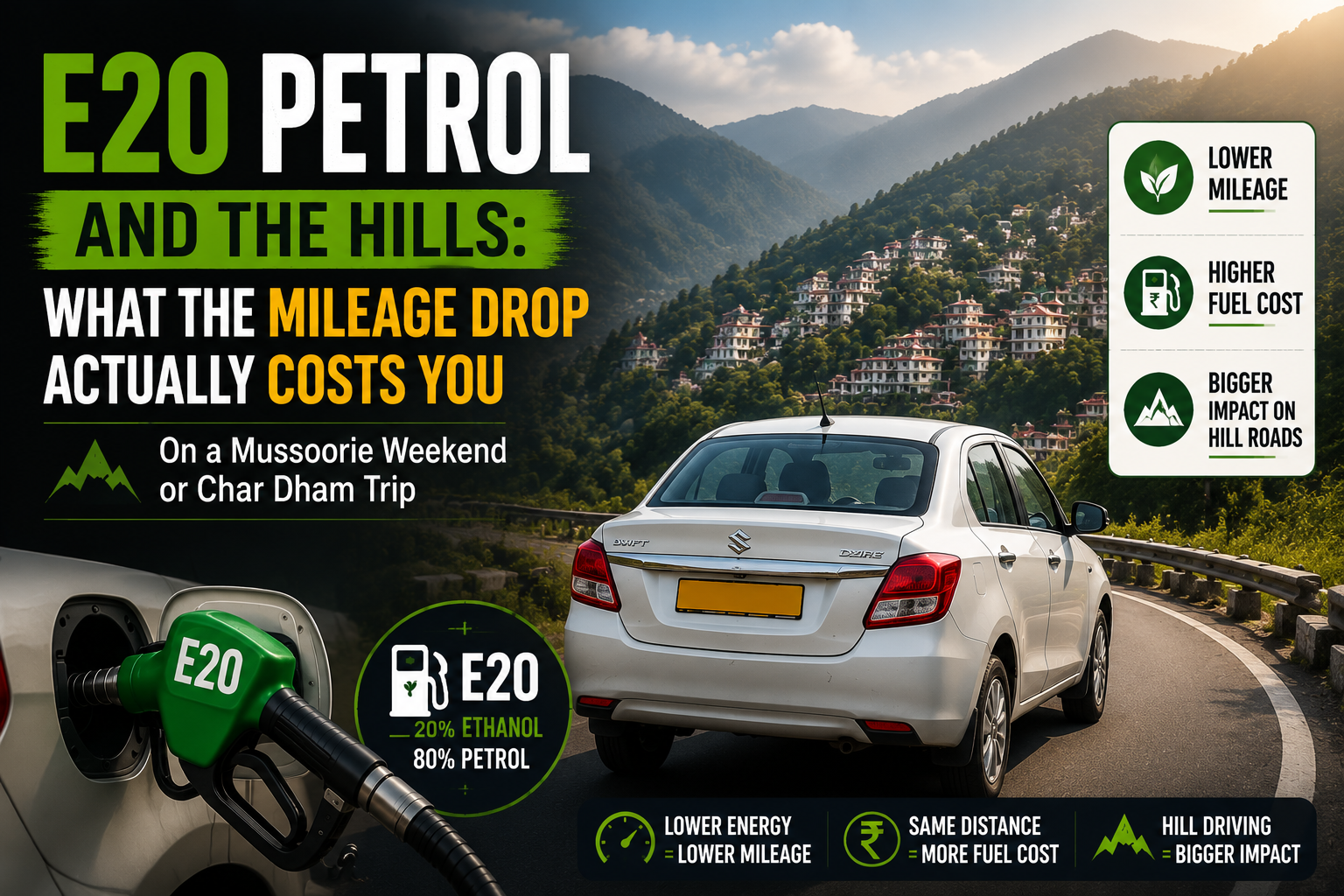
Quick Answer: E20 is a petrol blend — if you drive a diesel car, none of this affects you. For petrol cars made after April 2023, the impact is minimal. For pre-2023 petrol cars, the government estimates a 3–5% mileage drop, while a June 2026 survey of 44,000 owners found 66% reporting over 10%. On a 1,600 km Char Dham circuit, a 12% loss works out to roughly ₹1,800–2,000 in extra fuel. Call 7830211223 for a flat-fare package where fuel is included.
- First, the fair version of both sides
- What the government says
- What car owners say
- Is your car even affected?
- Now the bit nobody has written: E20 in the hills
- The arithmetic, shown honestly
- Three hill-specific things worth knowing
- 1. Cold starts at altitude
- 2. Ethanol absorbs moisture
- 3. Fuel pumps are far apart up there
- What you can actually do about it
- The honest taxi argument (there is one, and it's small)
- The bigger picture, fairly stated
- Or just let someone else worry about it
Since 1 April 2026, every litre of petrol sold in India is E20 — 20% ethanol, 80% petrol.
And ever since, the country has been having a loud argument about one number: how much mileage you lose. The government says a little. A great many car owners say a lot. We'll come to both.
But here is the question nobody seems to be asking, and it's the one that matters if you're reading this from Delhi with a Mussoorie weekend or a Char Dham yatra in your calendar:
What does E20 do on a mountain road?
Every test, every survey, every angry WhatsApp forward is about city and highway driving. Nobody has looked at what happens when your engine is climbing in second gear for four hours. We drive those roads for a living, so let's work it out honestly.
First, the fair version of both sides
This is a contested topic, and you deserve the honest picture rather than a rant.
What the government says
- The Automotive Research Association of India (ARAI) puts the efficiency dip at roughly 1–6%.
- The Ministry of Petroleum has acknowledged a decline of about 3–5% in some vehicles, and Nitin Gadkari has publicly accepted that ethanol's lower calorific value affects mileage.
- The case for the policy is genuinely substantial: India imports around 85% of its crude oil, and ethanol blending is projected to save tens of thousands of crores in foreign exchange annually, create demand for sugarcane and grain farmers, and cut carbon monoxide and greenhouse emissions. E20 also carries a higher octane rating (min 95 RON), which reduces engine knocking.
What car owners say
- A LocalCircles survey in June 2026, covering over 44,000 owners of pre-2023 petrol vehicles across 305 districts, found 66% reporting a mileage drop of more than 10% — up from 45% just a month earlier. 23% reported losses above 20%.
- In the same survey, 55% reported increased wear, tear or repairs — nearly double the previous month's figure.
- Independent real-world tests have pegged losses at 8–12% in older cars.
- Industry estimates suggest roughly 80% of vehicles sold in the last 15 years — close to 300 million cars and bikes on Indian roads — were never engineered for E20.
We're not going to tell you who's right. Both sets of numbers exist, and you can weigh them yourself. What we can do is show you what either figure means on a hill road, because that's our patch.
Is your car even affected?
Before anything else — check which bracket you're in.
| Your vehicle | What it means |
|---|---|
| Any diesel car | ? Not affected at all. E20 is a petrol blend. If you drive a diesel Innova, Crysta or Ertiga, none of this applies to you. Stop worrying and go on your trip. |
| Petrol, made after April 2023 | ? Built for E20 — ethanol-compatible fuel lines, seals and gaskets. Minimal impact. |
| Petrol, roughly 2020 – early 2023 | ? Designed for E10. Runs fine on E20, but expect a 3–7% efficiency drop and some long-term component wear. |
| Petrol, before 2020 (BS4 or older) | ? Highest risk. Reports of rough idling, cold-start trouble, faster degradation of rubber and plastic fuel-system parts, and the largest mileage losses. |
That first row surprises a lot of people. The entire E20 debate is a petrol debate. If you're diesel, you can skip to the end of this article and just enjoy the mountains.
Now the bit nobody has written: E20 in the hills
Here is the thing about a percentage. It stays the same. What it's a percentage of does not.
Hill driving is the most fuel-hungry thing you will ever ask of a car. Sustained climbs, low gears, high engine load, constant braking and re-acceleration through hairpins. Your car that returns 16 km/l on the Delhi–Meerut highway might manage 10–12 on the Mussoorie ghat, and less again on the Garhwal yatra roads.
So a 12% efficiency loss doesn't cost you the same everywhere. It costs you 12% of a much bigger number.
The arithmetic, shown honestly
These are illustrations, not promises — plug in your own car's real figures and fuel price. For reference, petrol in Dehradun retails around Rs 100.5-101 per litre (diesel about Rs 96) as of September 2026, so the Rs 100/litre column below is close to real money. But the shape of it is what matters:
| Trip | Approx. distance | Extra fuel at a 12% loss | Roughly, at ₹100/litre |
|---|---|---|---|
| Dehradun → Mussoorie return | ~70 km | Under a litre | Loose change |
| Delhi → Mussoorie return | ~600 km | ~5–6 litres | ~₹500–600 |
| Char Dham circuit | ~1,600 km, almost all mountain | ~18–20 litres | ~₹1,800–2,000 |
(Assumes a petrol car managing roughly 11–14 km/l on the relevant terrain before the drop. Your figures will differ.)
For a weekend in Mussoorie, this is not the reason to change your plans. Five hundred rupees on a trip that costs several thousand is noise.
For Char Dham in a pre-2020 petrol car, it's a different conversation — and the fuel bill isn't even the main issue. Which brings us to the part that actually worries us.
Three hill-specific things worth knowing
1. Cold starts at altitude
Ethanol is associated with cold-start difficulty in older, uncalibrated engines. Char Dham halts — Barkot, Uttarkashi, Guptkashi, Joshimath — sit at serious altitude, and mornings there are genuinely cold, even in June. If your car is old and already reluctant on a cold Delhi morning, a 4 AM start at 2,500 metres is not the moment to discover a new problem.
2. Ethanol absorbs moisture
If a car sits with a part-full tank for days — which is exactly what happens when you park at a hill station and walk around for a week — ethanol can absorb water and, in the worst case, separate out. Keep the tank fuller rather than emptier when the car is going to stand.
3. Fuel pumps are far apart up there
This has nothing to do with E20 and everything to do with the mountains, but it compounds the problem: on the Char Dham circuit, petrol pumps are sparse. If your real-world range has quietly dropped by 10–15% and you're planning your fill-ups on old assumptions, you will get caught out. Recalculate your range, and fill up when you can, not when you need to.
What you can actually do about it
- Check your owner's manual for the stated maximum ethanol limit (E5, E10, E20). This is the single most useful two minutes you can spend.
- Retrofit kits: Maruti Suzuki has been preparing E20-compatible upgrade kits — fuel lines, seals, gaskets — for cars up to 15 years old, reportedly around ₹4,000–6,000. Worth asking your service centre about if you have an older petrol car you intend to keep.
- Service the fuel system before a long hill trip. Injectors, filter, spark plugs. This is good advice regardless of E20 — but more so now.
- Track your own mileage across two or three tanks. Forget the surveys and the ministers; your own car will tell you the truth.
- Budget realistically. If you're driving your own car up for Char Dham, add a couple of thousand to the fuel estimate you had in your head.
The honest taxi argument (there is one, and it's small)
We're a taxi company, so you'd expect us to turn this into a sales pitch. Here's the modest, honest version.
Our fares are flat, and fuel is included. Whatever E20 is doing to efficiency, it affects our costs, not your quoted price. When you book a Char Dham package at a fixed fare, the fuel risk sits with us — and so does the cold start at Guptkashi, and the sparse pumps, and the fuel-system service afterwards.
That's a genuine advantage. It's also a fairly small one, and we're not going to pretend E20 is a reason to hire a taxi. The real reasons are the ones we've written about elsewhere — the parking situation in Mussoorie, the hill-road driving itself, and not wanting to spend your holiday reversing out of a hairpin bend.
If you have a diesel car and you enjoy driving: take it. Genuinely. E20 is not your problem, the roads are beautiful, and you'll have a lovely time.
If you have a pre-2020 petrol car and you're considering 1,600 km of Garhwal mountain road: think about it properly. Not because of the fuel bill, but because that's a hard trip for an old engine, and a breakdown at 3,000 metres is a bad day.
The bigger picture, fairly stated
India is moving further, not back. In May 2026 the Bureau of Indian Standards notified a standard covering E22 to E30 blends, and the government has been clear that the roadmap continues. Whatever you think of the mileage debate, ethanol-free petrol is not coming back.
So the practical position is simple: find out what bracket your car is in, track your own mileage, service the fuel system, and plan your hill trips with the real numbers rather than the ones you're used to.
Or just let someone else worry about it
We run a maintained fleet on these roads every day — the Mussoorie ghat, the Chakrata climb, the full Char Dham circuit. Fuel, servicing and fuel-system wear are our problem, and they're already inside the fare we quote you.
Book a Dehradun to Mussoorie taxi, come up from Delhi, or plan the full circuit with an Innova for Char Dham or a lighter Swift Dzire package. Watching the budget? See how to actually pay less.
Call or WhatsApp 7830211223. Flat fares, fuel included — and no arguments about ethanol.
Government positions, survey findings and retrofit pricing on E20 are evolving, and figures quoted here reflect reporting as of mid-2026. Check the current position before making a decision based on any of it.
Frequently Asked Questions

Skip the guesswork on routes, tolls and mountain driving. Book a fixed-fare AC cab for Char Dham Yatra with Anywhere Taxi Service — the fare is confirmed before pickup, tolls are listed upfront, and you get the driver's name and number in advance.
Char Dham Yatra fares & booking Call 7830211223
